If you run a greenhouse, flower farm, vegetable operation, orchard, or vineyard, sensors only pay off when data arrives consistently and correctly in a platform that turns it into decisions. That’s where terms that sound “IT-only” show up: LoRaWAN, NB-IoT, and MQTT.
In practice, these technologies describe three simple things: how sensors “talk” over distance, which network carries the message, and how an application like GrowGuard ingests it. Once you understand the data path, it becomes easier to choose between sensors, gateways, SIM plans, monthly costs, coverage, and the reliability level your operation needs.
This article explains—in grower-friendly language—how readings (temperature, air humidity, VPD, soil moisture, EC, pH) and device health signals (battery and sensor status) reach GrowGuard, including TTN API imports and MQTT data streams. Step by step, we connect the technical choices to daily actions: irrigation, fertigation, ventilation, heating, crop protection, and team coordination.
1) What connectivity really solves: from measurement to action
Most horticulture problems don’t come from a lack of data—they come from a lack of timely, trustworthy data. A sensor can measure accurately, but if it reports too rarely, drops messages, or goes offline without anyone noticing, decisions revert to guesswork.
Connectivity is the “transport” layer for your readings. Depending on your crop and site, that transport must be: long-range enough (distance), power-efficient enough (battery), stable enough (no gaps), and simple enough to manage (for a busy team).
GrowGuard’s job is to bring those readings into one place with live monitoring, a sensor map, integrated forecasts, alerts (including AI-assisted phytosanitary alerts), reports, and team access. But to get those benefits, it helps to understand how data reaches the platform and which choices increase the chances of a steady flow of information.
2) What to measure in practice and why it matters (regardless of network)
Before choosing LoRaWAN or NB-IoT, define which decisions you want to improve. Then select measurements that actually explain and support those decisions.
Air temperature and air humidity are foundational in greenhouses, tunnels, storage areas, and open-field blocks. From them you can calculate VPD (vapor pressure deficit), a highly useful indicator for plant transpiration, condensation risk, and climate comfort. In GrowGuard you can track trends, see cooler/more humid zones on the map, and set alert thresholds.
Soil moisture (or substrate moisture) directly drives irrigation. Measured correctly, it helps reduce “habit-based” watering, avoid water stress, and control variability between zones. For perennial crops (orchards, vineyards), it’s one of the most valuable data streams for block-level scheduling and for assessing irrigation uniformity (drip, micro-sprinkler). GrowGuard shows trends, comparisons between points, and can highlight anomalies (for example, a sudden drop suggesting a leak, a valve issue, or a regime change).
3) EC and pH: turning “numbers” into fertigation management
In hydroponics, substrates (coco, rockwool), or soil fertigation, EC and pH often translate quickly into action. EC (electrical conductivity) is a practical proxy for nutrient/salt concentration, while pH influences nutrient availability and root health.
In day-to-day management, it’s not just one “perfect” number that matters, but stability and direction: EC too high can indicate salt buildup; EC too low may suggest underfeeding or dilution. A drifting pH can signal issues in the recipe, water source, dosing, or system flushing.
With GrowGuard, EC and pH time series can be visualized and correlated with irrigations, recipe adjustments, and climate conditions. Reports also make it easier to align with your agronomist, fertigation team, or input distributor because you’re working from a clear history—not scattered notes.
4) LoRaWAN explained for growers: when it fits and how it works
LoRaWAN is a long-range, low-power communication technology widely used in agriculture for battery-operated sensors. A LoRaWAN sensor sends small data packets to a gateway (a local collection point) or to a public network, and from there the messages reach a network server.
Typical strengths: long battery life (depending on reporting interval), strong range, and potentially low operating costs if you run your own gateway. Typical limits: it’s not designed for large data volumes or very frequent transmissions; signal quality depends on terrain, vegetation, buildings, and gateway placement.
For greenhouses or farms with many measurement points (microclimate, soil, weather stations), LoRaWAN is often preferred when you want to avoid per-sensor SIM costs and keep local control of the network. For sensor distributors, LoRaWAN also supports scalable deployments with centralized management and integration into platforms like GrowGuard.
5) NB-IoT explained for growers: when a cellular network makes sense
NB-IoT (Narrowband IoT) is an IoT technology that uses mobile operator infrastructure. In simple terms, the sensor includes a cellular module (often with a SIM/eSIM) and sends data directly through the mobile network—no local gateway required.
Typical strengths: fast setup (no gateway to install), good coverage in many areas, and stable scheduled reporting when cellular signal is adequate. Typical limits: monthly/per-device cost, dependence on operator coverage, and sometimes higher power use than LoRaWAN in similar use cases.
NB-IoT is a strong option for isolated blocks, sites where installing a gateway is impractical, rapid rollouts, or distribution models where each device must operate independently across different regions. In GrowGuard, what matters is consistent delivery; the best technology is the one that fits your farm’s logistics and constraints.
6) MQTT explained for growers: the “language” that carries sensor messages
MQTT isn’t a radio network by itself—it’s a messaging protocol: a standard way for devices and applications to publish and receive data. In many architectures, a gateway, controller, or middleware publishes sensor messages, and applications (like GrowGuard) subscribe and ingest them.
Why MQTT matters: it makes integration more flexible. If you already run automation (climate, irrigation), a PLC, a multi-protocol gateway, or an on-site platform that can publish data via MQTT, you can often connect that information to GrowGuard without replacing the whole ecosystem.
From a manager’s perspective, MQTT typically means: “I can connect what I already have” and “I can bring multiple data sources into one shared dashboard.” For distributors, MQTT is frequently a requirement in projects where the end customer has an established IT/OT environment and expects interoperability.
7) How data reaches GrowGuard: three common paths (LoRaWAN, NB-IoT, MQTT)
No matter the technology, the chain is similar: measurement → transmission → device identification → interpretation (units, calibration) → storage → visualization and alerts → reports and decisions.
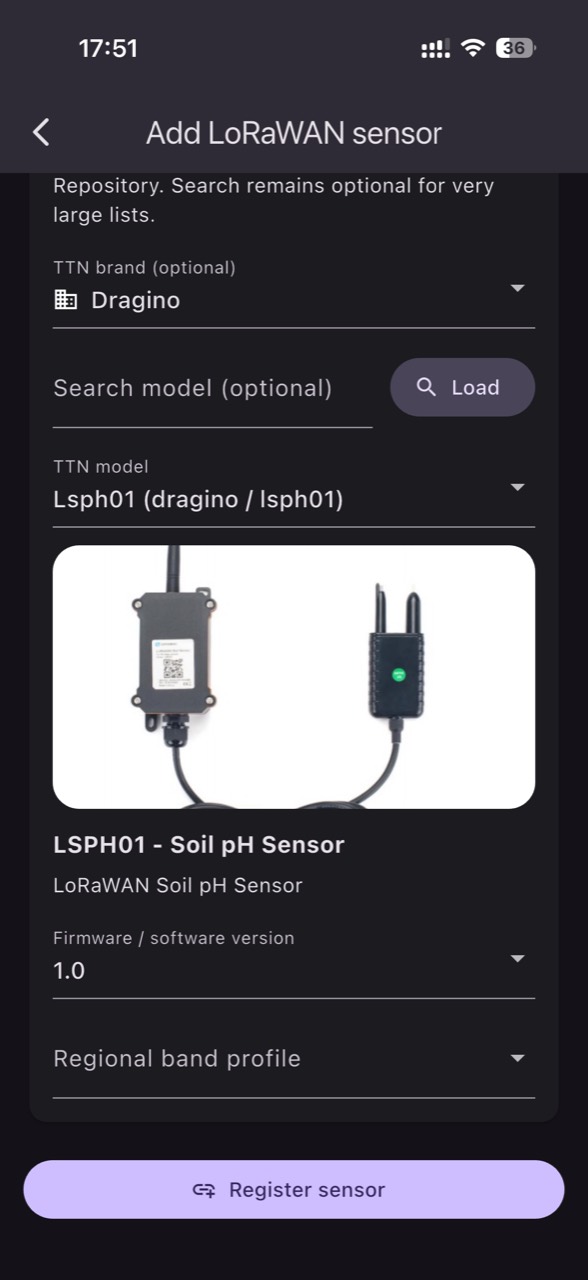
LoRaWAN path: the sensor transmits to a gateway or public network, then to a network server. If you use The Things Network/The Things Stack, a common integration method is TTN API imports: GrowGuard pulls messages (payload) and converts them into values (for example temperature, humidity, soil moisture, EC, pH, battery).
NB-IoT path: the sensor transmits via the mobile operator to a backend (the manufacturer’s or yours). GrowGuard can ingest the data through compatible integration methods (for example, integration endpoints or standardized messages) so you see everything in one interface, with the same alerts and reports you use for LoRaWAN.
8) TTN API imports: what to prepare so integration doesn’t stall
When connecting LoRaWAN sensors via TTN API, the most common blockers aren’t “advanced”—they’re about basic readiness: device identity, payload formatting, and access permissions.
In practical terms, you need: devices correctly registered in TTN, security keys and settings configured, a payload decoding method (so raw bytes become real units), and permissions/API keys that allow GrowGuard to read the data.
Operationally, validate early: the reporting interval (how often the sensor sends), message content (which fields are included: temperature, humidity, VPD-calculable inputs, soil moisture, EC, pH, battery), and that messages arrive consistently. In GrowGuard, beyond measurement charts, battery level and sensor status help you spot communication issues before they impact decisions.
9) What “data quality” means on a farm: interval, coverage, calibration, status
Good decisions require comparable data. That starts with a reporting interval that matches reality: too slow and you miss peaks (for example midday VPD spikes); too fast and you drain batteries or overload the network without real benefit.
Coverage and placement matter just as much. An air sensor placed near a door, fan, or heater can produce values that don’t represent the zone. A soil probe installed in an atypical spot (too dry or too wet) can push irrigation decisions in the wrong direction. GrowGuard’s sensor map helps you see what each point represents and coordinate with the team on relocations or adding new points.
Calibration and maintenance don’t disappear with digital tools. For pH and EC, periodic checks and consumables are part of the true cost. For soil moisture, interpretation depends on soil/substrate type and depth. GrowGuard supports you with history, comparisons, and reports, but agronomic meaning still depends on correct setup and measurement discipline.
10) What GrowGuard helps you notice: from microclimate patterns to phytosanitary risk
When your data is consistent, value comes from patterns. For example, the combination of temperature, humidity, and VPD can explain morning condensation, midday stress windows, or why one greenhouse bay behaves differently from another.
In orchards and vineyards, linking soil moisture trends with forecasts and weather events supports irrigation planning and reduces reactive decisions. In GrowGuard, forecasts and live monitoring work together: if a heat wave is coming, you can tighten alert thresholds and prepare your team.
AI-assisted phytosanitary alerts don’t replace field scouting, but they can help prioritize checks: when conditions become favorable for issues (for example long stretches of high humidity), the team can be prompted to inspect higher-risk zones. For faster in-field communication, AI Plant ID can support identifying symptoms or plants so the team can describe what they see more consistently.
Conclusion
LoRaWAN, NB-IoT, and MQTT aren’t just acronyms—they’re practical options that influence how consistently and usefully data reaches GrowGuard. LoRaWAN often fits many battery-powered points and local network control; NB-IoT simplifies deployments without a gateway in areas with good cellular coverage; MQTT helps connect existing systems and standardize data exchange.
Before choosing a technology, start with decisions: what you want to control (irrigation, fertigation, climate, phytosanitary risk), what you need to measure (temperature, humidity, VPD, soil moisture, EC, pH), and how much visibility you need into battery and sensor status. Then build the right data path: TTN API imports for LoRaWAN, NB-IoT ingestion via a backend, or MQTT streams.
With live monitoring, a sensor map, forecasts, AI-assisted alerts, AI Plant ID, reports, and team access, GrowGuard turns sensor readings into information you can act on. The outcome is tighter operational control and better-supported decisions—without relying on assumptions or occasional spot checks.