GrowGuard Blog

GrowGuard Blog: monitoring, sensors and crop decisions

GrowGuard articles about greenhouse monitoring, horticulture sensors, alerts, AI and data-driven crop decisions.

CO₂ under control in greenhouses/tunnels: how to link CO₂ with ventilation, VPD and temperature to avoid photosynthesis losses (a zone-based workflow in GrowGuard)
2026-06-17

CO₂ under control in greenhouses/tunnels: how to link CO₂ with ventilation, VPD and temperature to avoid photosynthesis losses (a zone-based workflow in GrowGuard)

CO₂ alone doesn’t tell the story. In greenhouses and tunnels, photosynthesis is lost quickly when ventilation, VPD and temperature aren’t aligned with CO₂ levels. Here is a zone-based workflow with thresholds, day/night alerts, and history checks in GrowGuard to turn sensor data into daily decisions.

Read article
Monitoring fungal disease risk (downy mildew, powdery mildew, botrytis) without guesswork: a practical workflow using humidity, temperature, VPD, critical time windows, forecast context, zone alerts, and history checks (GrowGuard)
2026-06-14

Monitoring fungal disease risk (downy mildew, powdery mildew, botrytis) without guesswork: a practical workflow using humidity, temperature, VPD, critical time windows, forecast context, zone alerts, and history checks (GrowGuard)

When downy mildew, powdery mildew, and botrytis seem to “come out of nowhere,” the microclimate usually sent signals first: high humidity, condensation, critical night/morning windows, and slow leaf drying. This guide shows how to turn sensor data (RH, temperature, VPD) plus forecast context into zone alerts, targeted scouting, and climate/phytosanitary decisions—with history verification in GrowGuard.

Read article
How to cut greenhouse/tunnel energy costs without risking the crop: a practical workflow with zone thresholds, time windows, temperature–humidity–VPD correlation, alerts, and history verification (GrowGuard)
2026-06-13

How to cut greenhouse/tunnel energy costs without risking the crop: a practical workflow with zone thresholds, time windows, temperature–humidity–VPD correlation, alerts, and history verification (GrowGuard)

Energy savings shouldn’t come from randomly lowering setpoints. In a greenhouse or tunnel, safer decisions rely on zone-based thresholds, time windows, and correlating temperature with humidity and VPD. This article gives a practical workflow with thresholds, alerts, history checks, and an energy audit approach using GrowGuard.

Read article
Sensor data audit + calibration/maintenance: how to spot drift, stuck readings, and installation errors using history, status alerts, and zone comparisons in GrowGuard
2026-06-12

Sensor data audit + calibration/maintenance: how to spot drift, stuck readings, and installation errors using history, status alerts, and zone comparisons in GrowGuard

A regular sensor data audit quickly shows whether measurements are trustworthy or whether a sensor is misleading you due to drift, stuck readings, low battery, or poor installation. In GrowGuard you can combine history, status alerts, and zone comparisons to decide when to recalibrate, relocate, or service sensors—before irrigation, ventilation, and fertigation decisions are driven by bad data.

Read article
Practical sensor placement guide for accurate microclimate data: where to place temperature/humidity, VPD, soil moisture, EC/pH sensors to avoid “pretty data, wrong decisions” (greenhouse, tunnel, orchard, vineyard)
2026-06-08

Practical sensor placement guide for accurate microclimate data: where to place temperature/humidity, VPD, soil moisture, EC/pH sensors to avoid “pretty data, wrong decisions” (greenhouse, tunnel, orchard, vineyard)

Practical sensor placement guide for accurate microclimate data: where to place temperature/humidity, VPD, soil moisture, EC/pH sensors to avoid “pretty data, wrong decisions” (greenhouse, tunnel, orchard, vineyard). Monitoring is not just seeing a temperature value on a screen. It is understanding crop context, comparing zones, receiving alerts and making decisions before plant stress becomes visible loss.

Read article
How to set alert thresholds that actually work: temperature, humidity, VPD, soil moisture, EC/pH and battery—by crop zone (not “one threshold for the whole farm”)
2026-06-07

How to set alert thresholds that actually work: temperature, humidity, VPD, soil moisture, EC/pH and battery—by crop zone (not “one threshold for the whole farm”)

Good thresholds don’t mean more alerts—they mean more relevant alerts. Set them by crop zone, growth stage, and real risk: frost/heatwave, VPD, soil moisture, EC/pH, plus battery and sensor status. Here’s how to turn GrowGuard sensor data into clear actions without drowning your team in notifications.

Read article
Orchard and vineyard monitoring: using sensors for risk, irrigation and interventions
2026-06-06

Orchard and vineyard monitoring: using sensors for risk, irrigation and interventions

Orchard and vineyard monitoring with agriculture sensors turns microclimate and soil variability into decisions: irrigation, frost/heat protection, disease-risk scouting, and targeted interventions. Learn what to measure, why it matters, what GrowGuard helps you notice, and how data becomes action through live monitoring, sensor maps, forecasts, AI-assisted phytosanitary alerts, and team-ready reports.

Read article
GrowGuard AI Plant ID: using plant photos together with field data
2026-06-05

GrowGuard AI Plant ID: using plant photos together with field data

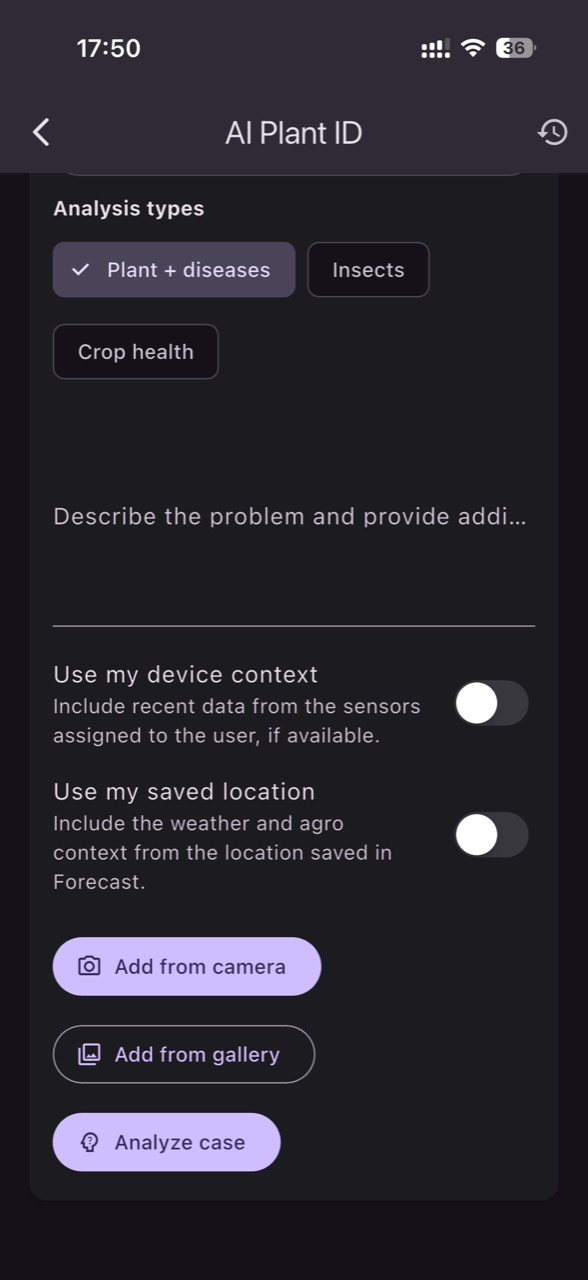
A good photo shows what you see. Field data explains why it happens. In GrowGuard, AI Plant ID becomes far more useful when paired with measurements like air temperature, air humidity, VPD, soil moisture, EC and pH, plus history and forecast. This article walks through what to photograph, what to measure, how to validate plant diagnosis (pests diseases), and how to turn sensor data into team-ready actions.

Read article
Sensor maps: why crop zones matter more than isolated readings
2026-06-02

Sensor maps: why crop zones matter more than isolated readings

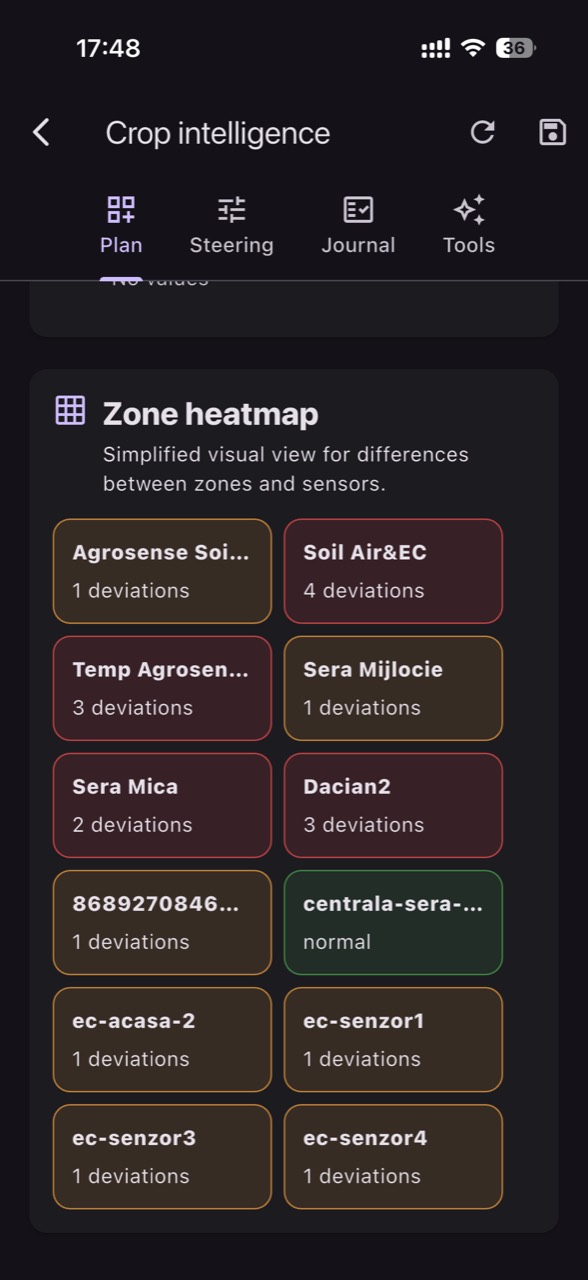
A single “average” value can hide local problems: uneven irrigation, microclimates, disease risk, or heat stress. A sensor map helps you see crop zones, compare points fast, and turn live monitoring into action: irrigation, ventilation, VPD management, nutrition, and planning.

Read article